
Monday 7th September 2026
Introduction
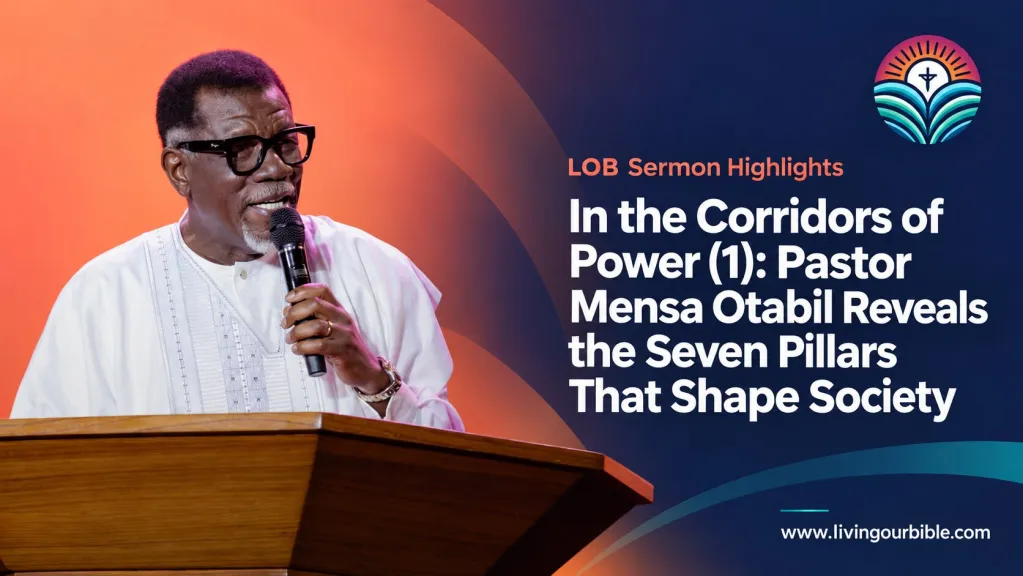
In the opening message of his series, In the Corridors of Power, Pastor Mensa Otabil (General Overseer of ICGC) examines power, influence and the Church’s responsibility within the systems that shape society. Drawing lessons from Daniel, Samson and Jeremiah, he challenges Christians to move beyond personal survival and become godly influencers in the world.
Daniel entered Babylon as a captive teenager but eventually served four kings as a trusted adviser. Although he was not a king, his wisdom enabled him to influence kingdoms and establish godly agendas. According to Pastor Otabil, “To have influence, you have to rise from a place of lowliness to a very high place.”
Called to Be the Head
Deuteronomy 28:13 declares that God will make His people “the head and not the tail.” Pastor Otabil explains that the head initiates, leads and determines direction, while the tail merely follows.
“The head sets the tone. The head sets the agenda,” he states. Therefore, believers must reject a passive mentality and recognise that Christ has called the Church to be the light of the world, the salt of the earth and a city set on a hill.
The Power of Pillars
Using Samson’s final act in Judges 16:25–30, Pastor Otabil illustrates how pillars sustain entire systems. When Samson pushed the two central pillars of the Philistine temple, the whole structure collapsed.
“When pillars stand, systems stand. When pillars are moved, systems collapse,” he explains. A pillar is a reliable foundation, a support structure and something that must remain upright. In the same way, human society rests upon foundational institutions that determine how people think, live and relate to one another.
The Seven Pillars of Society
Drawing from Proverbs 9:1, Pastor Otabil identifies seven pillars that support society:
- Family gives people identity and provides society’s first structure.
- Culture supplies beliefs, values, customs and meaning.
- Education determines what people know and how they understand the world.
- Media communicates what is happening and shapes how events are interpreted.
- Science reveals what is possible and drives technology and innovation.
- Business controls money, resources and economic power.
- Government makes decisions and manages society.
“Those who control these seven pillars control how the rest of us live,” he warns. These pillars are often moved by people and institutions possessing knowledge, wealth or power.
Understanding the Times
Although Christians may not possess the greatest financial or political power, they can influence society through spiritual discernment and timely action. Like the sons of Issachar, believers must understand the times and know what ought to be done.
Daniel and Joseph influenced nations because they combined divine insight with practical solutions. Pastor Otabil therefore urges the Church to stop concentrating solely on internal disputes while major cultural and social changes unfold around it.
Embracing the Church’s Prophetic Mission
From Jeremiah 1:4–10, Pastor Otabil outlines four responsibilities for believers: embrace their prophetic mission, see themselves as overseers of nations, courageously pull down ungodly structures, and build righteous pillars.
“Your life is not just you and your survival,” he declares. Christians must enter education, culture, media, science, business, government and family life as principled leaders who protect truth and advance God’s purposes.
Conclusion
The Church has been called to shape society, not merely react to it. Believers must understand the systems governing the world, seize opportunities and rise as godly power brokers. As Pastor Otabil concludes, “We need Christians who would go and hold one of these pillars and say, ‘This is my pillar.’”
About LivingOurBible.Com
LivingOurBible.Com is a Christian teaching and media platform committed to declaring the whole counsel of God through biblical, practical and life-transforming content that equips believers to understand, live and share God’s Word.